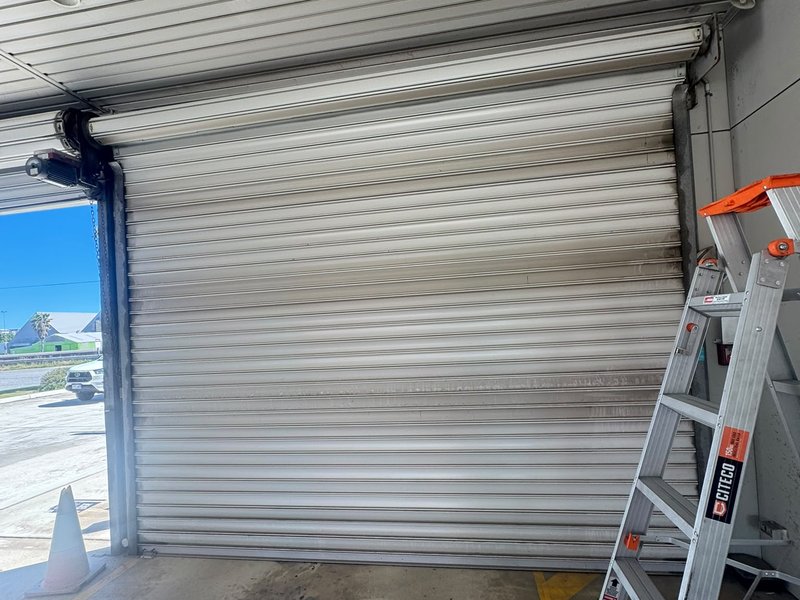
Most standard commercial roller door sizes in Australia fall between 2,100mm and 5,500mm high and 2,400mm and 5,400mm wide. Where your door lands in that range depends on what has to pass through it, from a ute and a pallet jack to a semi-trailer reversing onto a loading dock.
Size is also the hardest thing to change once a door is installed. Order a door 100mm too low and you will find out the first time a loaded truck noses in.
Our in-house crews measure openings across Perth every week, from Welshpool to Wangara, and this guide shares the numbers we actually work with: standard heights and widths, the headroom and side room a door needs, and how size shapes materials, security and price.
Standard Commercial Roller Door Sizes At A Glance
Most suppliers group commercial roller doors into four broad size bands. Widths across all of them typically run from 2,400mm to 5,400mm, and large industrial openings go wider still.
| Door Category | Typical Height | Common Uses |
|---|---|---|
| Small commercial | 1,500mm to 2,400mm | Storage units, kiosks and bin stores |
| Light commercial | 2,100mm to 3,000mm | Shopfronts, strata car parks and small workshops |
| Workshop and medium industrial | 3,000mm to 4,200mm | Mechanical workshops, trade units and factory bays |
| Heavy industrial | 4,000mm to 5,500mm | Warehouses, drive-in truck bays and mining sheds |
Large industrial openings generally exceed 4,200mm high and 4,500mm wide. At that end of the range, industrial roller doors are engineered for wider spans, with heavier curtains and stronger springs. Anything outside these bands can be manufactured to order, so treat the table as a starting point, not a limit.
How To Choose The Right Size For Your Site
Start with the tallest and widest thing that will pass through, then add clearance. Clear opening size matters because it is the usable space once the door is fully open, and the bottom rail and guides always take a little back from the structural opening.
Trucks are the usual deciding factor. Most heavy vehicles on WA roads top out at 4.3 metres, and permitted livestock and car carriers reach 4.6 metres, so a drive-in door needs clear height comfortably above that. Doors on raised loading docks, where only the back of the trailer meets the building, can sit much lower. Perth warehouses with drive-in bays usually need heavy industrial sizes.
Width follows the same logic. Trucks can be 2.5 metres wide, so we like at least 3,500mm of opening for vehicle access, which gives drivers room to reverse without clipping the guides. Forklifts matter too: measure your tallest unit with its highest regular load, and on busy docks consider a wider span so two can pass and the site stays operational at peak times.
We would rather talk you into an extra 200mm now than watch a driver scrape a new curtain in week one.
Headroom, Side Room And Measuring Your Opening
A roller door needs space around the opening as well as the opening itself. Plan for roughly 450mm of headroom above the lintel for the curtain and drum, and more on tall doors because the rolled curtain grows with height. Side room for the mounting brackets generally runs from 100mm to 250mm on each side, with extra on the motor side.
When our technicians measure a site, they record five things:
- Opening width at the top, middle and bottom, in millimetres
- Opening height at both sides and the centre
- Headroom from the lintel to the lowest obstruction above
- Side room on each side, including downpipes, columns and switchboards
- The tallest vehicle, forklift or load that will pass through
Floors in older industrial units are rarely level, so we focus on the smallest measurement, because that is the one that counts. You deal with the technician who measured, not a sales rep, so any quirk in the opening is sorted long before roller door installation day.
Materials And Key Features By Door Size
Bigger doors need robust materials. Most commercial doors use galvanised steel, often powder-coated, which resists salt corrosion and heat damage on exposed Perth sites. Aluminium is lighter and naturally resists corrosion, which suits some coastal and food-handling premises, though steel is the stronger choice on wider openings.
Roller doors use a single corrugated curtain, while roller shutters are built from interlocking slats. Industrial roller shutters are designed for heavy-duty use in industrial settings, and their slats can be perforated for ventilation, which is why they are popular in strata car parks and bin stores.
Other key features scale with the door, and so do the benefits. Insulated roller doors keep heat out and make cool rooms more efficient through a Perth summer. Nylon-lined guides give noise reduction for quiet, smooth operation near offices and neighbours. A printing process can even put your brand on the curtain, in colours matched to your signage, though it adds cost and lead time.
Wind Ratings And Perth Conditions
Wind-loading requirements are critical for commercial doors in open industrial zones around Perth, such as the Kwinana industrial area, where there is little shelter from winter storms. The bigger the door, the more wind it catches, so large doors often need to be wind rated, with wind locks and reinforced guides that stop the curtain bowing or popping out.
The Perth climate also demands designs that handle strong UV. Long, hot summers fade cheap finishes, so specify UV-stable colours and check the motor’s operating temperature range. Near the coast, durable materials that stand up to salt spray and the elements are worth the extra spend. Exposed mining and agricultural sheds face the same wind and UV, plus a lot more dust.
Security And Theft Protection For Commercial Premises
For many businesses, the roller door is the largest opening in the building and often its weakest point. Commercial roller shutters create a physical barrier against theft and unauthorised access, and high-grade steel shutters withstand forced entry attempts far better than lighter residential products.
Warehouse security improves again when the door is part of a wider system. Industrial roller shutters can integrate with alarms and CCTV systems, so a forced door triggers an alert rather than a nasty surprise at opening time. Some insurers may also lower premiums for well-secured sites, so it is worth asking yours.
Size plays a part too. A wide curtain flexes more under a pry bar, so larger openings need heavier gauges and extra locking points to keep stock and assets secure.
How Door Size Affects Price
Price climbs with size, material and the motor. As a guide, industrial roller shutters cost around $3,100 to $12,950 installed, commercial sectional doors range from $3,750 to $21,400, and high-speed rapid-roll doors run from $11,900 to $27,000.
Big, busy doors also need heavy-duty roller door motors built for high-frequency use, and installation complexity affects the overall cost, from lift hire to steel framing. Add insulation or a wind rating and the price rises again. Industry prices have also risen by around 5% recently, so an older quote may no longer hold.
Maintenance, Cleaning And Service Life
High-quality roller shutters need minimal day-to-day maintenance, but regular servicing extends their life. Scheduled maintenance checks spring tension, guides, locks and the motor to ensure reliable operation, especially on large doors that cycle all day.
Maintaining a clean door is easy. Brush dust and grit out of the guides every few months and wash salt off the curtain on coastal sites. Regular cleaning keeps the door quieter and eases the load on the springs.
If something does go wrong, our after-hours crew handles emergency roller door repairs across Perth, but a door that has been looked after rarely needs that call.
Frequently Asked Questions
Here are the sizing questions Perth business owners ask us most often.
What Is The Most Common Commercial Roller Door Size?
There is no single standard. For shopfronts and small workshops, doors between 2,100mm and 3,000mm high cover most jobs, while warehouses and drive-in bays usually need 4,000mm or more.
Can A Roller Door Be Made To A Custom Size?
Yes. Commercial roller doors and shutters can be customised for size and operation, and most are manufactured to order once the opening is measured. Standard sizes can shorten lead times and lower cost, but a door that fits properly matters more.
How Much Headroom Does A Commercial Roller Door Need?
Allow around 450mm above the opening for the curtain and drum on a typical commercial door, plus 100mm to 250mm of side room each side. Taller doors need more, so confirm with a site measure.
Is A Commercial Roller Door Different From A Garage Door?
Yes. A residential garage door for a house is built for a few cycles a day, while a commercial roller door uses heavier steel, stronger springs and a motor designed for constant use.
Do Large Commercial Roller Doors Need A Motor?
Not always. Big doors can run on a manual chain hoist, but high-frequency sites usually motorise for speed, safety and convenience, ideally with a manual override for power outages.
Final Thoughts On Commercial Roller Door Sizes
Standard commercial roller door sizes give you a useful starting range, from light commercial doors around 2,100mm high to heavy industrial doors of 5,500mm. The right size for your site depends on what passes through, the space around the opening and the conditions it faces.
Guessing is expensive, and a free on-site measure is not. Our crews have installed more than 5,000 doors across Perth, and we will size, supply and fit a door that suits your site. Book your free commercial roller door measure through our short online form, or call (08) 7813 3665 and we will come back to you within one business day.

Tyler started Glide Roller Doors with one van and a phone, and he still quotes the bigger commercial jobs himself. He's worked with commercial and garage doors for more than 15 years.